The Strategy
Digital Transformation of the Residential Sector from Design Phase to Operation
The single-family home pilot project demonstrates how private owners can directly benefit from BIM methodology and Digital Twin technology from the earliest project phases. Traditionally, advanced asset digitalization was reserved for large corporations or complex infrastructures. With POWERBIM, data management is democratized, allowing the connection of BIM models developed in Autodesk Revit and hosted in BIM360 with bidirectional analytical dashboards
in Power BI.
The scope of the work performed is divided into several areas:
- 3D BIM MODELING AND INFORMATION STRUCTURING (REVIT)
- CONTROL OF BUILDING SYSTEMS AND DATA IN THE DESIGN PHASE
- ACCESSIBLE VISUALIZATION FOR THE NON-TECHNICAL OWNER
- CDE INTEGRATION AND COLLABORATIVE MANAGEMENT (BIM360)
- REAL-TIME INTERACTIVE ANALYTICS (POWER BI)
- MODEL PREPARATION FOR LIFECYCLE AND O&M
Developed Technologies
Development of complete digital models in Autodesk Revit, integrating architectural, structural, and MEP (Mechanical, Electrical, Plumbing) disciplines with a structured information level suitable for exploitation.
Centralization of documentation and models in the cloud via BIM360, facilitating seamless collaboration between the owner, designers, and construction company without data loss.
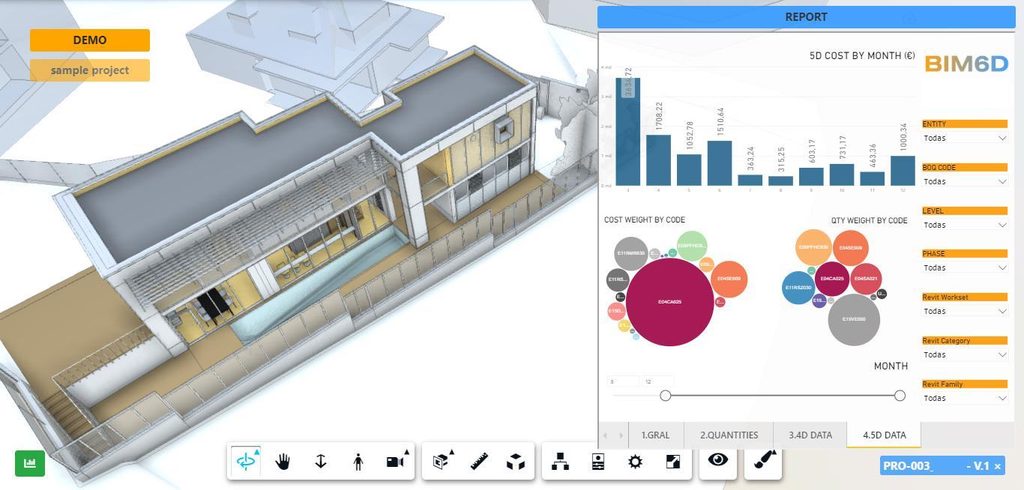
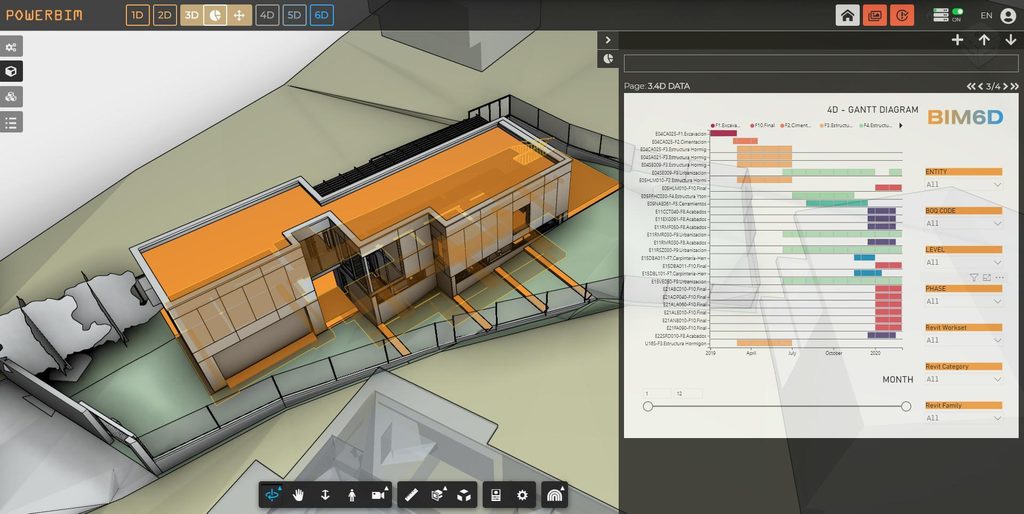
Bidirectional connection between the BIM model and dashboards in Power BI. Allows real-time analysis of costs, areas, material specifications, and compliance with requirements.
Intuitive web interface that allows the end-client (without technical BIM knowledge) to navigate their home’s 3D model, consult finish characteristics, and understand the building’s operation.
Integration of equipment and technical installation databases, allowing for early supervision of climate, electrical, and energy efficiency systems during design.
Structuring of the asset database for its subsequent use phase, facilitating preventive maintenance tasks, warranty management, and efficient operation of the single-family home.