Technical Approach to POWERBIM
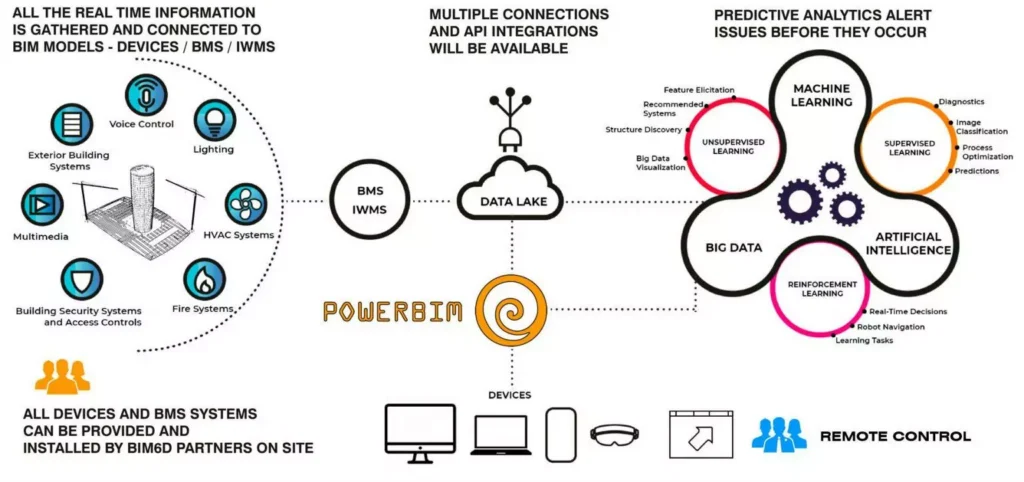
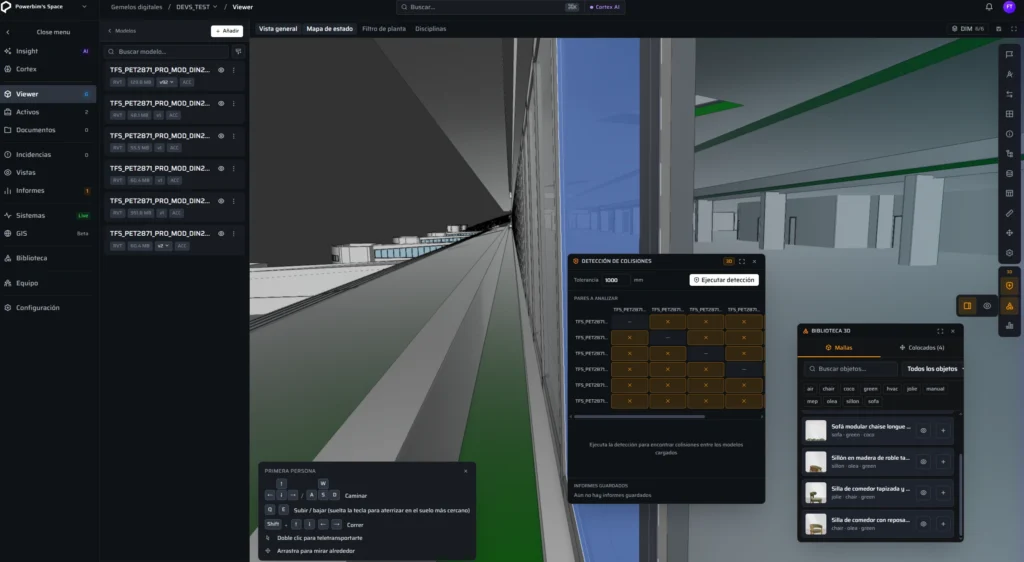
Below is a summary of the main functions available in POWERBIM based on BIM and Data, serving Asset Management and Building Operation throughout its life cycle.
Content
- Upload digital models from Autodesk Construction Cloud
- Create custom dashboards with Microsoft Power BI
- Real-time collaboration through data analysis
- Activate one or more dimensions in each project
- Integrate systems for asset life cycle management
- Evolve your assets from Smart Buildings to The Smart City
- Remote building operation through simulations and artificial intelligence
Upload digital models from Autodesk Construction Cloud
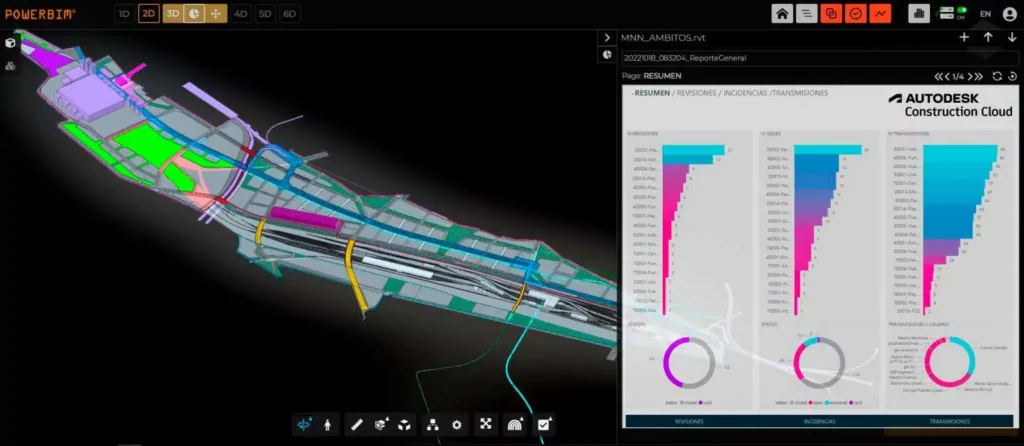
POWERBIM extends the capabilities of Autodesk Construction Cloud when used as a BIM Common Data Environment; both platforms synchronize many of their functions bidirectionally, while POWERBIM includes new functions oriented towards data analysis and asset management.
- POWERBIM models originate from the Autodesk Construction Cloud environment
- Various file formats are supported (IFC, Revit, Navisworks, AutoCAD, Civil3D, Plant3D, Rhinoceros, fbx, etc.).
- Model federation (including IFC and other formats) and independent adjustment of model positions.
- Ability to create general dashboards from processes across the entire Hub (Data Transfers, Reviews, Issues)
- Issues are automatically synchronized with ACC
Create custom dashboards with Microsoft Power BI
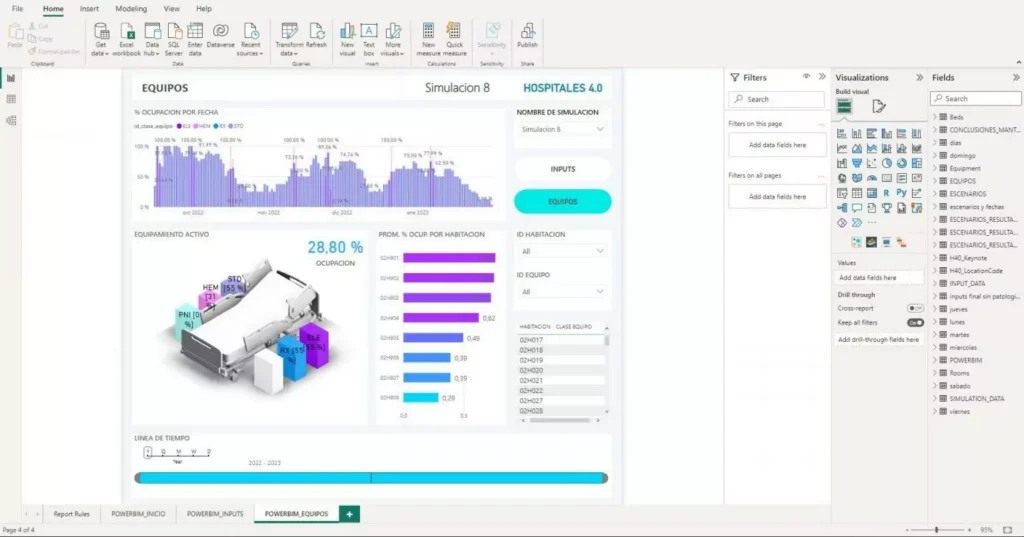
POWERBIM is a unique platform for automating data analysis. Users can create custom data reports in Power BI from information in digital models uploaded to Autodesk Construction Cloud, interactively connecting data charts with related model components.
The goal is to create a solid database structure for the subsequent steps in Digital Twin integration for design, construction, or facility management purposes.
- Invoke attributes from models loaded in POWERBIM to generate your own standard based on the required information.
- Connect and combine external data sources from files, cloud platforms, and other software using Microsoft Power BI functions.
- Connect with POWERBIM processes to create dashboards (asset inventory, issues, rule sets, or custom tables for each project).
- Once your custom report is ready, you can use it across all your projects.
Data analysis can be used for various purposes in the AECO sector (audit models, integration of clash detection results, takeoffs, budgeting, planning, energy simulations, and much more).
Real-time collaboration through data analysis
Discover a new way to collaborate with stakeholders using data analysis dashboards combined with BIM methodology, creating your own KPIs based on your requirements or automating the identification of components that match your established rules.
By collaborating through data, your team will have control over your asset information; data can be grouped by categories, assigned to issues or work orders and sent to external systems, or relevant information from your Common Data Environment can be attached.
- Autodesk Construction Cloud roles are combined with POWERBIM roles based on data access permissions.
- Integration of the OpenBIM BIM Collaboration Format (BCF) standard for issue management.
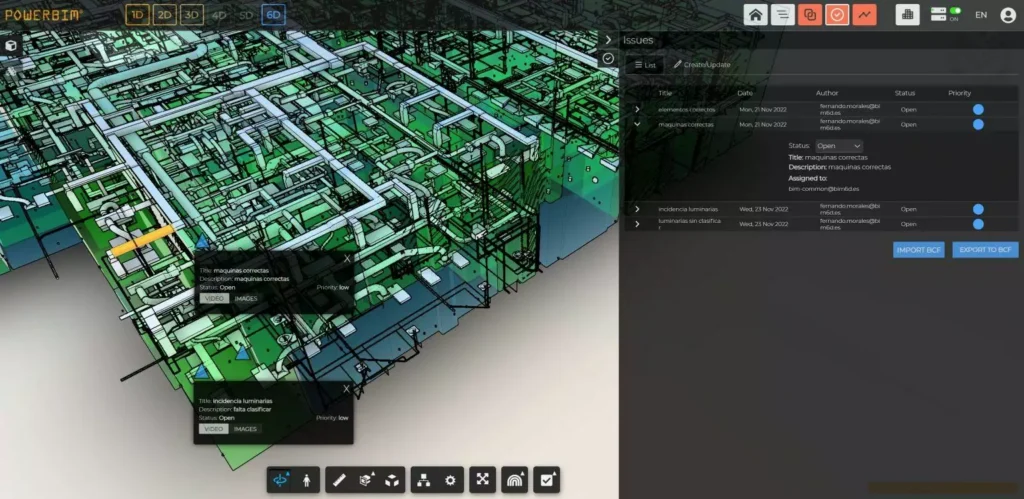
- Issues synchronized with the CDE are displayed in POWERBIM; users can attach documents, links, and videos, and they can be integrated into CMMS or BMS systems to automate building operation.
- POWERBIM automates the identification of assets in your digital model based on rule sets, so you can create your inventory according to your criteria and assign the relevant information.
Activate one or more dimensions in each project
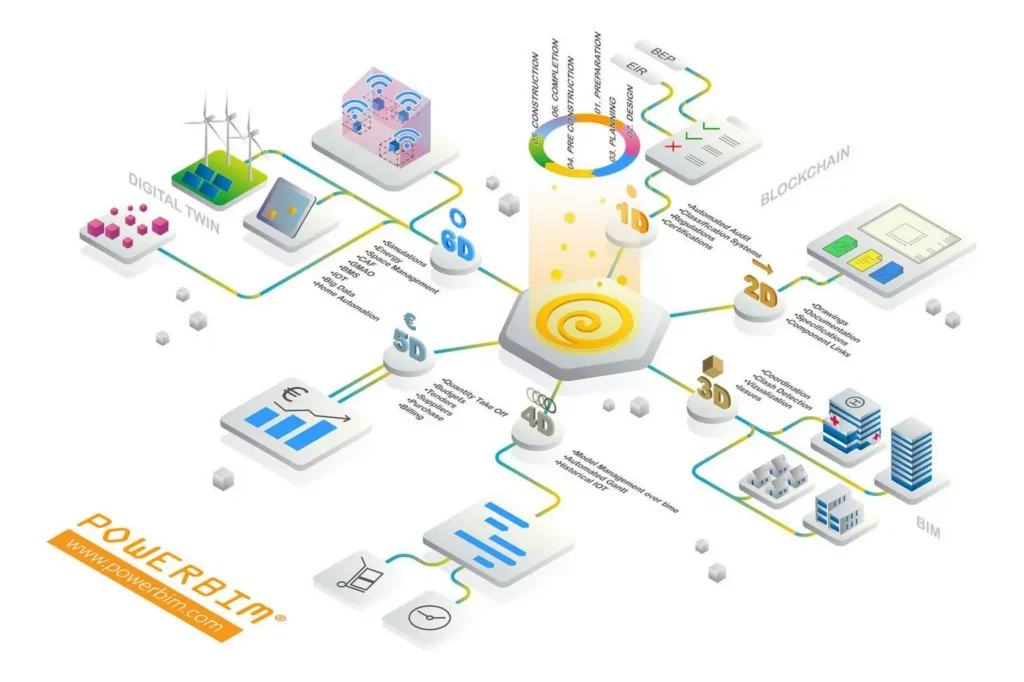
Every project is different; not all digital models will be used for building operation or energy performance scenario simulation. We understand that data is valuable at all stages and for different purposes. In POWERBIM, you can activate dimensions at any time you need them, each with a specialty:
1D – Quality assurance and control, data tables, rule sets to be applied to create lists of grouped components for inventory creation or simply to organize them using a classification system.
2D – Document management, with the ability to create screenshots, animations from them, and data transfer between Autodesk Construction Cloud or another Data Management platform like Microsoft SharePoint. Assign documents and links to assets.
3D – BIM / GIS environments, model federation, and coordination work.
4D / 5D – Extraction of takeoffs and generation of budgets linked to BIM components in a simple way.
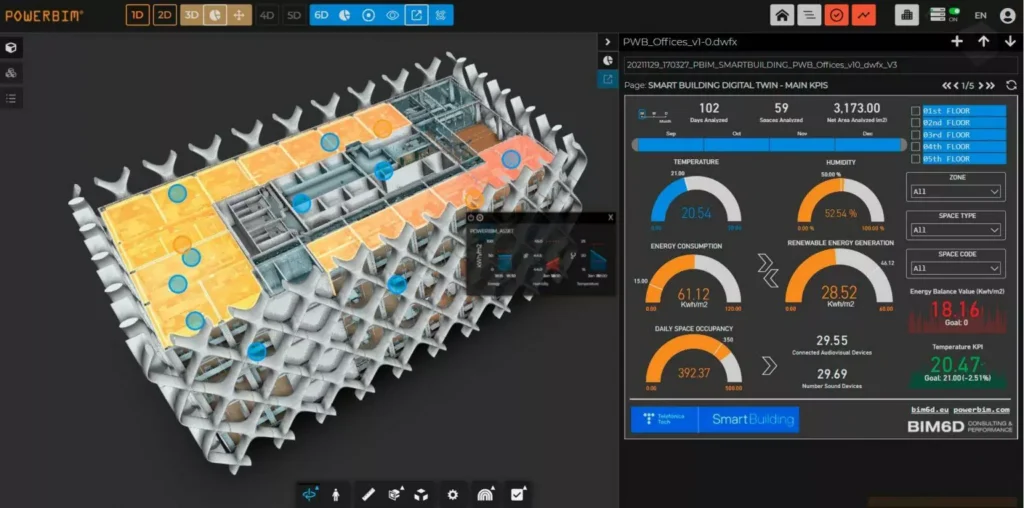
6D – This dimension is designed to simulate data from various sources for energy performance or sustainability, asset management, building operation, predictive analysis, or computer representation.
Integrate systems for asset life cycle management
The goal of digitizing your assets is to simulate multiple scenarios for systems that have a critical impact on the organization’s business model.
The return on investment in Digital Twin is around 30% for Construction and Facility Management compared to standard technologies. This is thanks in part to the immediacy and simplicity of access to the information to be managed (there is no other way) and also thanks to the possibility of anticipating future problems by creating predictive analytics based on current data.
Some use cases in which we have participated in POWERBIM integrations:
- Unmanned Remote Inspection Systems (drones, cameras)
- ERP integration for business data connected to BIM spaces
- Monitoring and simulation of people positioning and building evacuation simulation
- Connection of Smart City Data + Smart Building Data
- BMS integration with HVAC systems
- SCADA integration for the industrial and healthcare sectors
- IoT devices and real-time or historical multimedia data
- Energy and Sustainability Simulations compared with real-time data
Evolve your assets from Smart Buildings to The Smart City
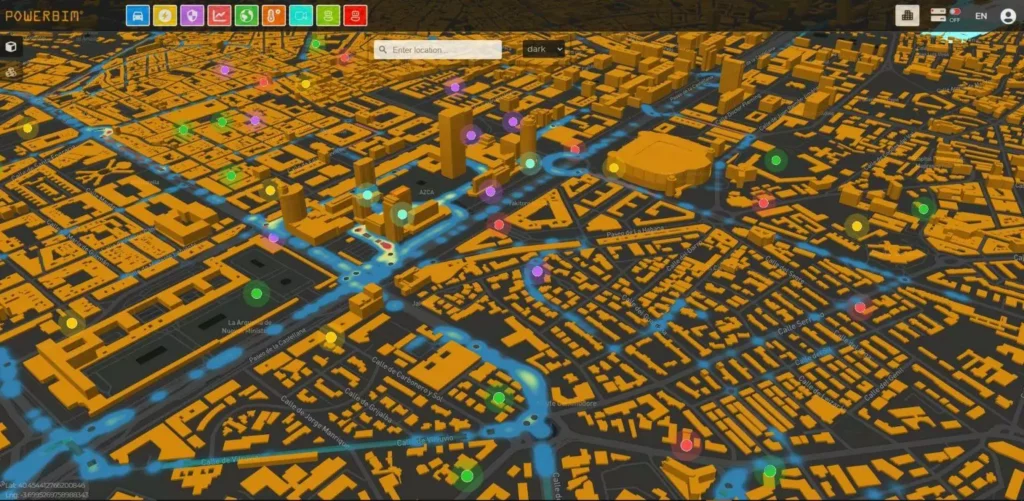
If you need to manage several assets in the same location or specific area, you can create a cluster—that is, a group of projects that interact with each other and with the urban environment. Thanks to GIS technology, you can create various layers of information, including public and private data in real time, or customize integrations based on needs.
The goal is to achieve management of Smart Buildings integrated into Smart Cities, combining interactively connected BIM and GIS technologies.
Users will be able to create three-dimensional shapes in GIS to represent one or more assets in specific locations.
Assets can be assigned to a calendar, so the asset manager can plan the growth of the real estate business.
The user will be able to assign BIM models to 3D shapes in the GIS, linking BIM development to the GIS.
Various databases can be created, including GLTF models that are automatically created in POWERBIM.
Public city data available in real time or custom integrations can be included, thus creating a digital data ecosystem at various scales (Cities + Buildings).
Remote building operation through simulations and artificial intelligence
Once POWERBIM is being used in one or more assets, integrating various data sources, it will be time to simulate and take advantage of Digital Twins using Artificial Intelligence. The power of data in your hands.
POWERBIM is the only platform that allows the use of advanced Microsoft Azure Services analytics automatically integrated into Autodesk Construction Cloud. However, there are more options available and others on the way. Below are the integrated technologies for Digital Twin available in POWERBIM:
- Microsoft Azure (IoT Hub / Synapse Analytics / Cognitive Services)
- Siemens Mindsphere Platform (industrial IoT infrastructure)
- Amazon Cloud Services
- Google Cloud Services
- CMMS / CAFM / IWMS Platforms
- SCADA Platforms
- BMS / EMS Platforms
- ERP Cloud Solutions
- IoT devices and systems
- Any cloud-based solution